A new research article entitled “Written in the soil: Record of prehistoric subsistence agriculture in semi-arid foothills of Tien Shan, SW Kyrgyzstan” has been published in the prestigious international journal CATENA.
The article was written by Atilla Vatansever, Lenka Lisá, Martin Janovský, Abdinabi Kadyrov, Jakub Trubač, Jozef Chajbullin Koštial, Libor Petr, Aleš Bajer, Ivo Světlík, Pavel Lisý, Petr Kočár and Kadicha Iskandarovna Tashbaeva. The research brought together archaeology, geoarchaeology, soil science, geochemistry, radiocarbon dating and GIS analysis, and was supported by the Central Asian Research Society (CARS).
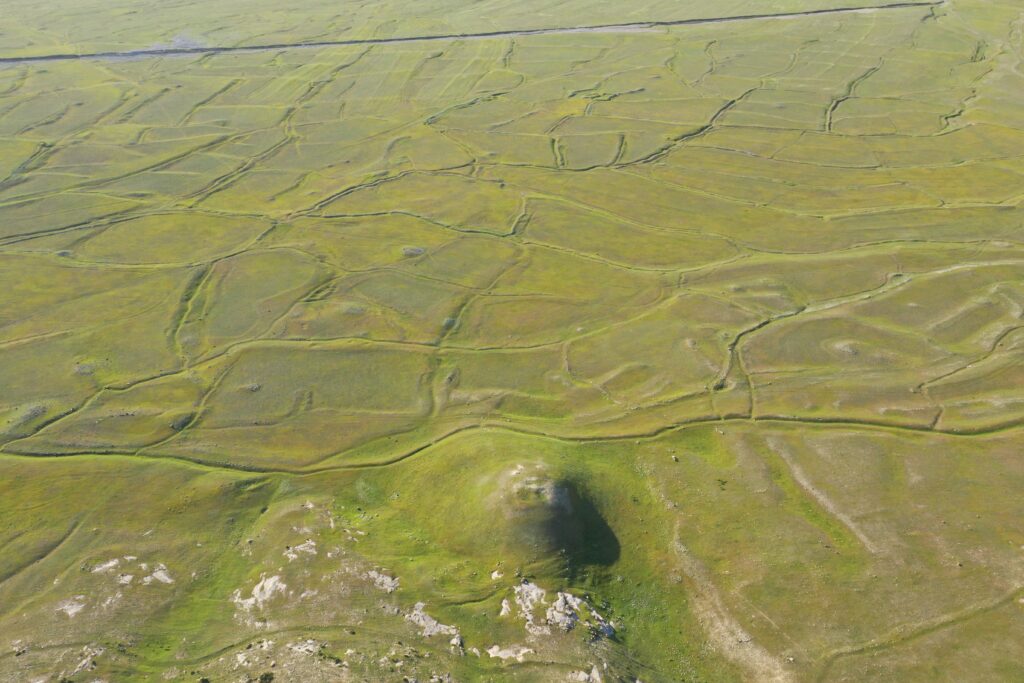
The study focuses on the exceptionally well-preserved agricultural landscape surrounding the village of Ravat in south-western Kyrgyzstan. Researchers documented more than 120 sections of irrigation canals with a combined length exceeding 25 kilometres, over 90 fields covering approximately 60 hectares, and 45 homestead enclosures connected to the canal network. The results indicate that individual households or farmsteads cultivated their own plots while sharing a coordinated system for distributing seasonal water from the Shadymyr Mountains.
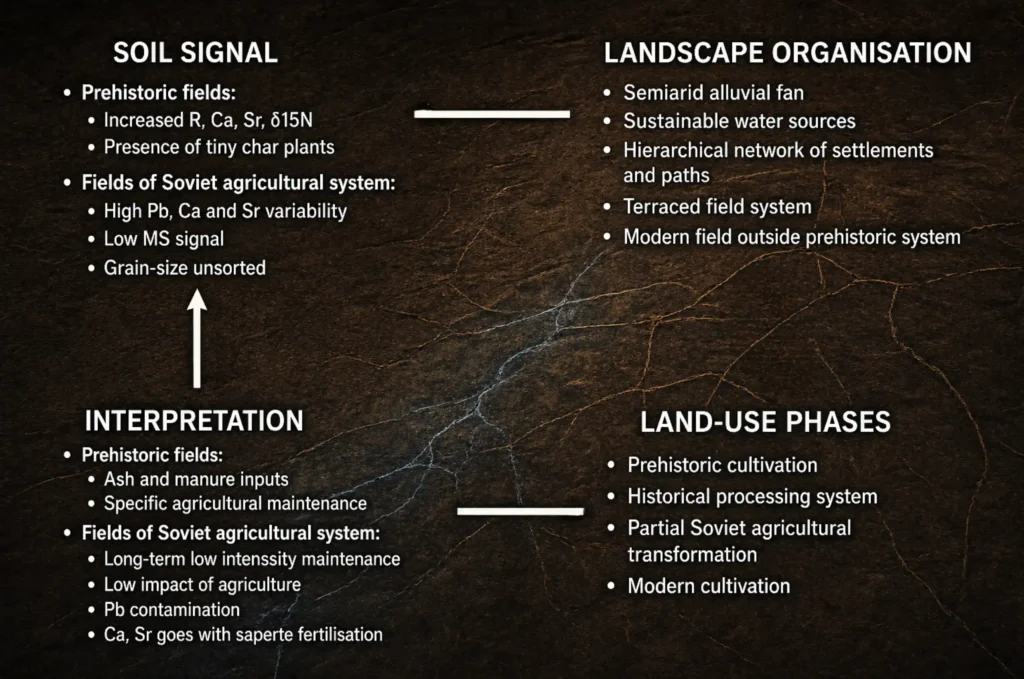
The most important new evidence comes directly from the soil. Geoarchaeological analyses revealed clear differences between prehistoric fields, Soviet-period fields and land cultivated today. The prehistoric soils preserve traces of long-term, low-intensity organic fertilisation, probably involving animal manure and the temporary use of fields for keeping livestock. Isotopic results also point to the cultivation of C₄ crops, most plausibly millet, in some parts of the system.
The Ravat landscape did not simply flourish and then suddenly collapse. The evidence instead suggests repeated use, transformation and later reactivation. Its main agrarian phase is tentatively connected with the broader Davan/Dayuan horizon, while selected parts of the landscape were reused during later historical periods.
The article shows that the history of agriculture is preserved not only in settlements and artefacts, but also in canals, field boundaries and the chemical composition of the soil itself.
Read the full article in CATENA