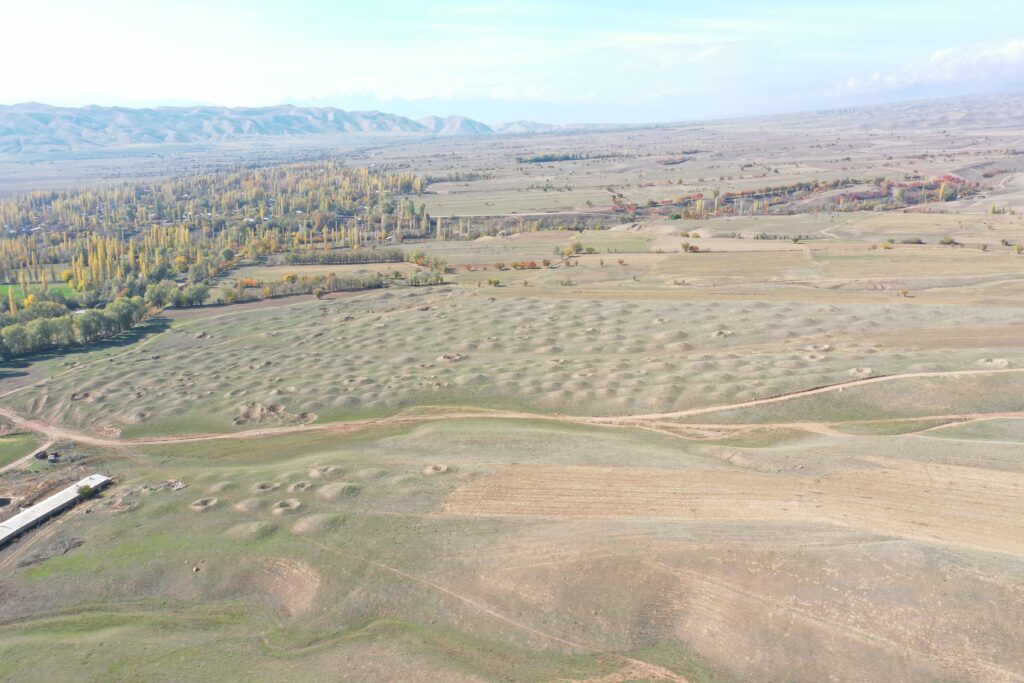
When driving through the high-mountain valleys of the Tian Shan or gazing at the horizons of Lake Issyk-Kul, you cannot miss them – Kurgans. These burial mounds, which have shaped the face of the Kyrgyz landscape for millennia, are not merely silent hills of earth and stone. They are fascinating open-air archives, concealing stories of the rise and fall of powerful nomadic empires and daily life at the crossroads of the Silk Road.
Architects of the Steppe: From Bronze to Iron
The tradition of building burial mounds in Kyrgyzstan is not a one-off phenomenon but evolved in several distinct waves. We find the first significant traces as early as the Late Bronze Age (roughly 2nd millennium BCE). Communities of that era began creating the first small kurgan cemeteries, often lined with stone structures in the form of circles or squares. In the Bronze Age (e.g., the Andronovo culture), we encounter smaller groups or isolated objects rather than massive complexes. Structurally, these were stone chests (cists) embedded in the ground, covered by a low embankment with a stone ring (kerege). These early monuments testify to a deep spiritual connection between the inhabitants and specific locations in the landscape.
The true “Golden Age” of burial mounds arrived in the Iron Age (c. 8th – 3rd century BCE) with the emergence of the legendary Saka. These eastern relatives of the better-known Scythians transformed kurgan construction into both an art form and a political manifesto. The elite mounds of Saka chieftains reached monumental proportions. So-called “Royal” kurgans (e.g., in the Chuy or Talas valleys) exceed 10 meters in height and 50–100 meters in diameter. The core was constructed by layering river boulders, gravel, and sod, ensuring stability and insulation. Beneath the embankment lay a wooden burial chamber made of juniper beams, sometimes equipped with a dromos (an entrance passage). Their scale directly demonstrated the power and wealth of the clan. Due to the specific climate and construction, these structures have preserved rare artifacts, ranging from weaponry to exquisite jewelry in the famous “animal style.”
Medieval Transformation and the Mysterious Balbals
A major turning point in the history of Kyrgyz kurgans occurred in the Middle Ages (from the 6th century CE onwards) in connection with the massive expansion of Turkic peoples. This wave brought not only a new power structure but also a significant shift in the region’s settlement patterns. Nomadic groups, which previously resided mainly in high-altitude areas, began descending into the valleys. This directly disrupted the space of original agricultural oases (Sogdians), who were gradually pushed out or forced to integrate into the nomadic political system. This process led to profound social changes and a transformation of the region’s cultural map.
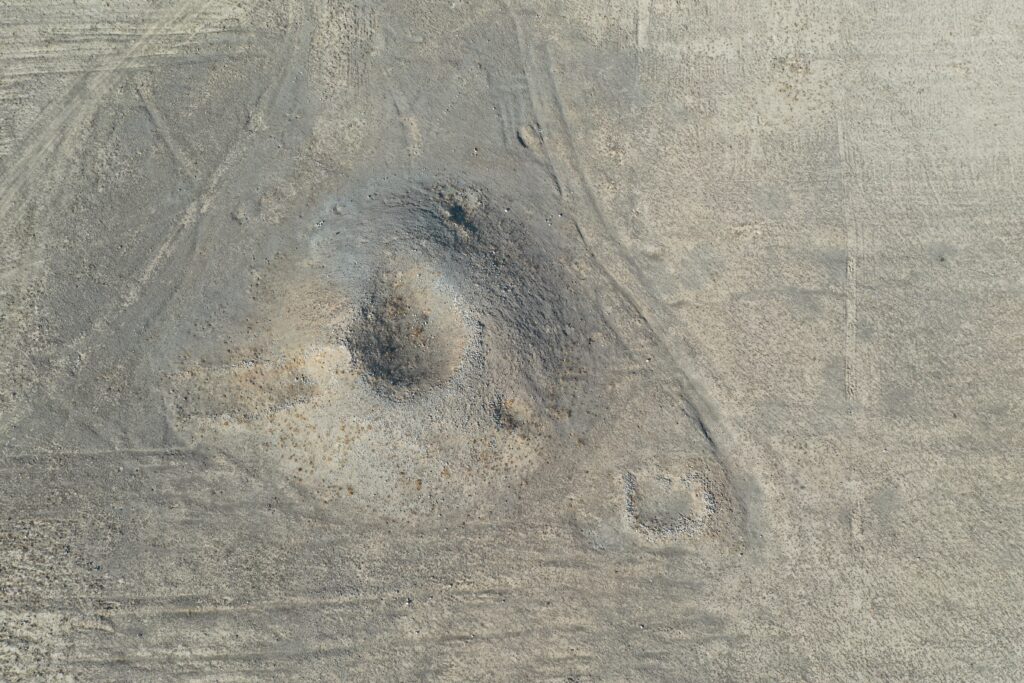
Medieval kurgans are structurally more subtle but ritually richer. They often consist of skeletal burials in shallow pits, where the deceased is interred alongside their saddled horse (a ritual typical of the Turks). Stone enclosures and balbals appear on the surface. Interestingly, the tradition of kurgan burial survived in remote areas of Kyrgyzstan (e.g., At-Bashy) well into the modern era, where original shamanic rituals began to blend with Islamic elements. This led to the creation of specific cemeteries called mazars, which indirectly follow the kurgan tradition through the use of sun-dried mud bricks (saman).
While the tradition of mound burial continued, the emphasis shifted toward external ritual accompaniment. This era produced the iconic balbals – stone stelae carved in the likeness of warriors. These statues, often standing in long rows near the mounds, were not merely tombstones. They were intended to represent either revered ancestors or defeated enemies meant to serve the deceased nobleman in the afterlife. Balbals thus became a clear symbol of the new Turkic elites’ dominance over the landscape.
A Mosaic of the Ancient World
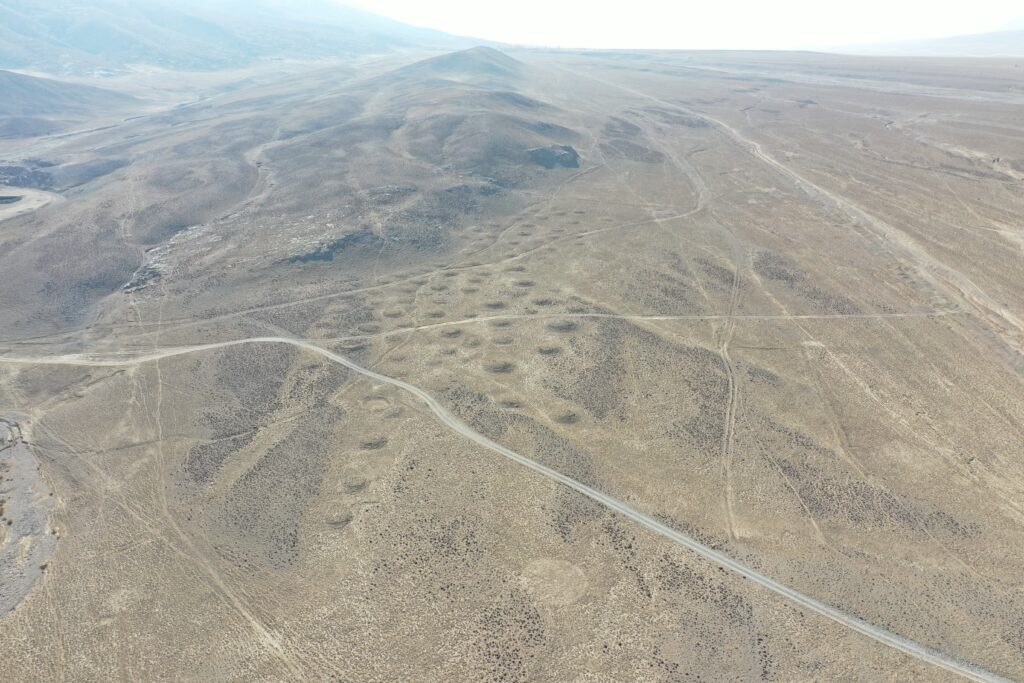
Today’s research into these monuments, which we also pursue within the activities of the CARS association, is no longer just about digging. We utilize modern remote sensing methods, drones, and geophysical techniques to map entire burial grounds without damaging them. This helps us understand not only the construction technology but also how kurgans influenced ancient routes and settlements along the Silk Road. Each mound is a piece of a mosaic helping us protect the cultural heritage of Kyrgyzstan and better understand the fascinating world of ancient nomads.
Honestly, I dont think kurgans are Kyrgyz, or Central Asia specific phaenomenon.
People generally bury under mounds (even today in Europe – see the grave mound slightly raised above the surrounding terrain). In Central Asia this phenomenon is just more visible – due to the absence of agriculture, which “smoothes” out terrain “anomalies” and due to grazing, which removes the grass cover and the kurgans are more visible.