The study by Boxleitner et al. titled as Archaeobotanical investigations at high-elevation sites of the Pamir Mountains and fergana foothills: iScience presents an important contribution to our understanding of prehistoric subsistence strategies and the spread of cultivated plants across Central Asia. The combination of archaeobotanical analyses, direct AMS radiocarbon dating of plant remains and the synthesis of data from the Fergana foothills and the Eastern Pamirs provides valuable new chronological evidence for the dispersal of cereals and the exploitation of wild plant resources. The paper also contributes significantly to the ongoing discussion regarding the role of the Inner Asian Mountain Corridor (IAMC) in prehistoric cultural interactions. The archaeobotanical dataset is impressive. The large volume of floated sediment from Surungur, together with systematic sampling, direct dating of plant macroremains and careful taxonomic identification, creates one of the most comprehensive archaeobotanical datasets currently available from southern Kyrgyzstan. The discussion of broomcorn millet, foxtail millet, wheat and barley is thorough and integrates the new results well with the existing literature from Kazakhstan, Tajikistan, China and the broader Central Asian region. Likewise, the evidence for long-term exploitation of walnut and pistachio provides an important addition to discussions concerning the management of wild forest resources in the Fergana region.
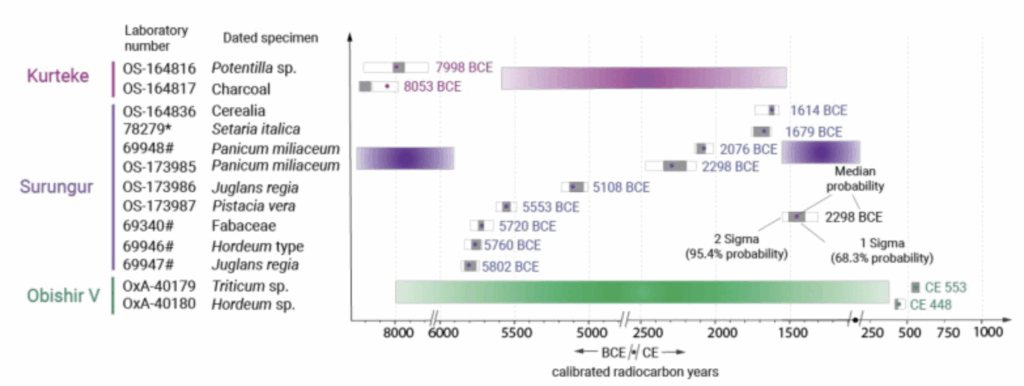
From the perspective of a geoarchaeologist working for many years in southern Kyrgyzstan, however, I believe that the study would substantially benefit from a stronger geoarchaeological framework. The paper is essentially written from an archaeobotanical perspective, whereas the sedimentary context in which the botanical assemblages accumulated receives only limited attention. This becomes particularly important because all three investigated sites are rock shelters, where depositional and post-depositional processes are inherently complex. The authors correctly acknowledge that sedimentation within rock shelters may complicate archaeological interpretation, yet this issue is not developed further. Rock shelters in Central Asia commonly experience repeated cycles of colluvial deposition, roof collapse, bioturbation, cryoturbation and anthropogenic reworking. These processes can significantly affect the vertical and horizontal distribution of plant macroremains. Consequently, interpretations regarding the timing of crop introduction and human activities should be supported by a more explicit discussion of site formation processes. This issue is particularly relevant in the foothills of the Fergana Valley, where sedimentation is strongly controlled by episodic runoff, debris flows and slope instability. Geoarchaeological studies from southern Kyrgyzstan have repeatedly demonstrated that archaeological horizons may represent palimpsests formed over long periods rather than discrete occupation events. Without a more detailed sedimentological analysis it remains difficult to assess whether individual plant remains represent primary deposition, secondary redeposition or post-depositional mixing.
Another aspect that deserves greater consideration is landscape evolution. Throughout the manuscript the Inner Asian Mountain Corridor is discussed primarily as a route for the movement of crops, animals and people. However, the environmental conditions that enabled or constrained agriculture receive relatively little attention. Agricultural expansion cannot be understood solely through the presence or absence of cultivated species. It also depends on geomorphological stability, soil formation, hydrological conditions and water availability. This issue is especially important in southern Kyrgyzstan. Research carried out on sites such as Ravat and Ak Jar demonstrates that settlement development and agricultural intensification were closely connected to the evolution of alluvial fans, river terraces and irrigation systems. These geomorphological factors largely determined where agriculture could develop and remain sustainable. Integrating this broader landscape perspective would considerably strengthen the archaeological interpretation presented in the paper. The absence of pedological information represents another limitation. Although the archaeobotanical evidence convincingly documents the presence of cultivated plants, the paper provides little information regarding the soils in which these crops may have been cultivated. Micromorphological observations, soil chemistry, phosphate analyses or magnetic susceptibility could provide valuable information concerning cultivation practices, trampling, manuring and site maintenance. Such analyses would also help distinguish between places where crops were processed, consumed or actually cultivated.
The interpretation of cereal remains also deserves a more cautious discussion. The authors themselves acknowledge that the recovered grains may have been transported to the sites rather than cultivated locally. Nevertheless, some parts of the discussion and conclusions occasionally imply local cultivation in high-elevation settings. From a geoarchaeological perspective, the presence of a limited number of grains alone cannot demonstrate local agriculture. Such an interpretation would ideally require additional evidence, including cultivation soils, irrigation features, field systems, abundant processing waste or a characteristic weed flora associated with cultivated fields.
The discussion of fuel use represents one of the strongest parts of the paper. The comparison between charcoal abundance and densities of weedy seeds provides an elegant approach for distinguishing wood and dung fuel, and the authors successfully integrate these observations with previous sedimentological and palynological studies. Nevertheless, further geoarchaeological analyses, particularly micromorphology of combustion features, would provide an independent line of evidence supporting these interpretations. One important issue that is almost absent from the discussion concerns water management. Agriculture in the Fergana Basin has always depended upon the spatial and temporal availability of water. The manuscript discusses the dispersal of crops in considerable detail but pays comparatively little attention to hydrological conditions, irrigation potential or geomorphological controls on water distribution. These factors are fundamental for understanding prehistoric agriculture in Central Asia and deserve greater consideration in future research.
Despite these comments, the study clearly represents an important contribution to Central Asian archaeology. The quality of the archaeobotanical analyses, the direct dating programme and the regional synthesis make this paper one of the most significant recent archaeobotanical studies from the western sector of the Inner Asian Mountain Corridor. The new chronological evidence will undoubtedly become an important reference for future discussions concerning the spread of agriculture across Eurasia.
In conclusion, this paper significantly advances archaeobotanical research in Central Asia. Its greatest strength lies in the high-quality botanical dataset and the careful chronological framework. Its principal weakness is the limited integration of geoarchaeological evidence. Future studies combining archaeobotany with sedimentology, micromorphology, pedology and landscape evolution will undoubtedly provide an even more robust understanding of how prehistoric communities adapted to the environmentally diverse landscapes of the Fergana Valley and the Pamirs.