A new research article entitled “Designing the Foothills: Prehistoric Irrigation, Fields, and Rural Settlement at Ravat, South-western Kyrgyzstan” has just been published in the prestigious journal IANSA (Interdisciplinaria Archaeologica – Natural Sciences in Archaeology).
The article is authored by Atilla Vatansever, Lenka Lisá, Jozef Chajbullin Koštial, Libor Petr, Aleš Bajer, Kadicha Iskandarovna Tashbaeva, and Alsu Chajbullinova a multidisciplinary team integrating archaeology, geoarchaeology, geology, archaeobotany, and environmental sciences. Several of the authors are members of the Central Asian Research Society (CARS), within whose framework the research agenda at Ravat has been developed and coordinated.

Ravat: A Landscape That Should Not Have Survived
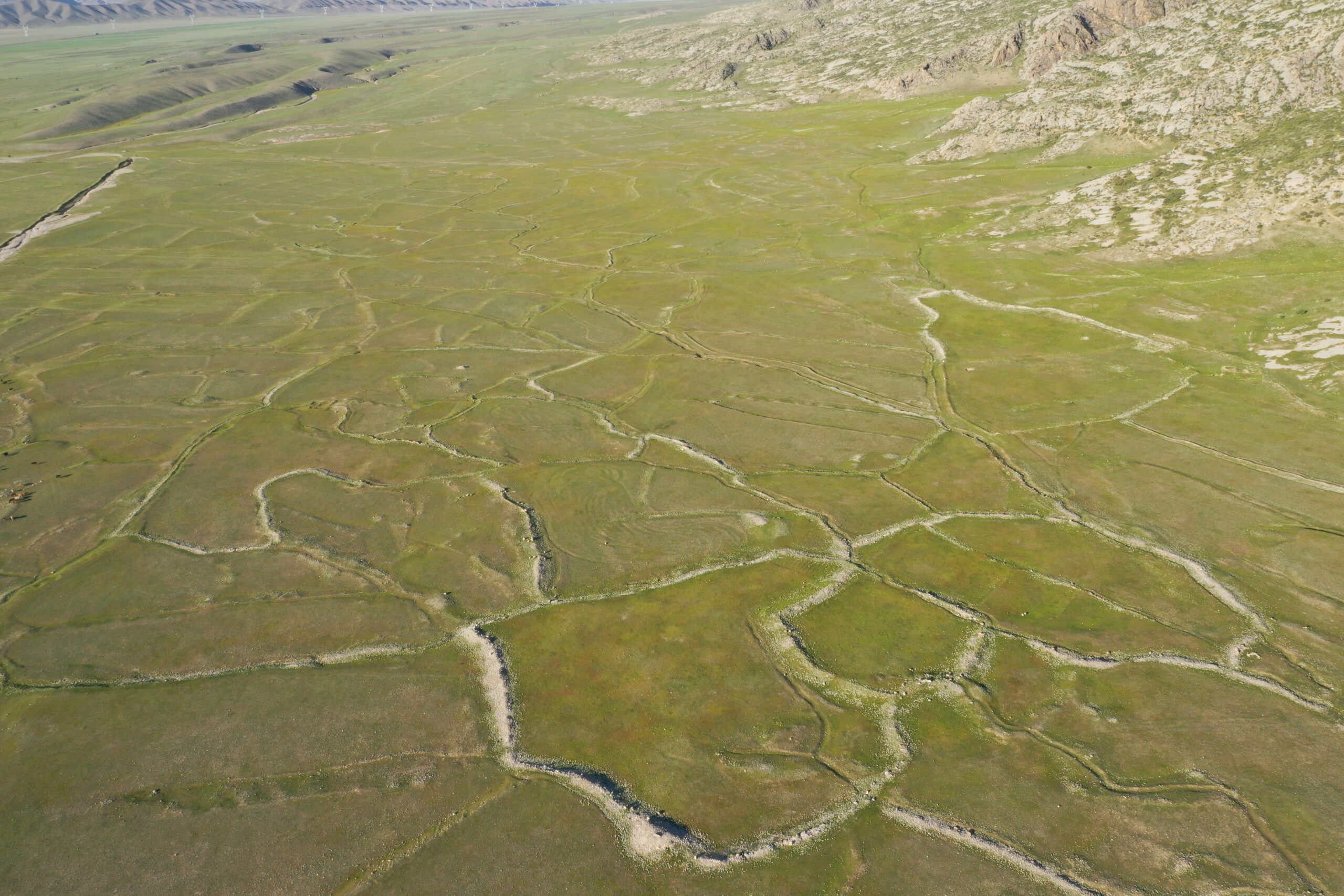
The article presents the site of Ravat, located in south-western Kyrgyzstan at the interface between the Shadymyr Mountains and the semi-arid Ferghana Basin, as one of the most exceptionally preserved ancient agricultural landscapes currently known from Central Asia. The documented complex comprises a central tepe with architectural remains, an extensive system of terraced fields, a hierarchically organised irrigation network, road systems, and clusters of small homestead units distributed across the lateral ridge of a large alluvial fan.
Based on surface archaeological evidence, geomorphological observations, and landscape morphology, the system is broadly dated to the 4th century BC–4th century AD, corresponding to the Davan Period—a long-term cultural horizon characterised by interaction between sedentary agricultural communities and mobile pastoralist groups in the northern Ferghana region. Crucially, the entire landscape escaped later intensive agricultural reuse and modern construction, allowing its structure to survive in an unusually intact form.
Agriculture, Water Management, and Environmental Limits
A central contribution of the article lies in its detailed characterisation of ancient water-management strategies in a semi-arid and environmentally risky setting. The Ravat system demonstrates a sophisticated understanding of local hydrology, with terraces and irrigation channels designed to capture spring precipitation, stabilise soils, and mitigate seasonal drought.
The spatial organisation of fields, canals, and settlement units reflects not only technical knowledge but also a degree of supra-household coordination and long-term planning. At the same time, the system’s eventual abandonment, indicated by burial mound complexes superimposed on agricultural infrastructure, highlights the limits of resilience inherent in foothill agricultural systems exposed to climatic variability, shallow soils, and shifting socio-economic strategies.
Ravat as a Reference Landscape for Central Asia
Methodologically, the article offers a robust preliminary characterisation of a newly identified archaeological landscape, based on satellite imagery, low-altitude drone documentation, ground survey, and non-invasive geological coring. While extensive excavation has not yet been undertaken, the results already position Ravat as a key reference locality for future research on ancient agriculture, hydrology, and settlement organisation in Central Asia.
In a broader interpretative framework, Ravat is presented as a model landscape for exploring long-term human–environment interactions, sustainability thresholds, and land-use strategies in the mountain–steppe interface. Its exceptional preservation allows processes of agricultural adaptation, stress, and eventual abandonment to be examined with a clarity rarely achievable elsewhere in the region.
Outlook and the Role of CARS
The publication in IANSA marks an important milestone in a long-term research trajectory focused on Ravat and comparable landscapes in the Pamir-Alay and northern Ferghana regions. Within the framework of the Central Asian Research Society (CARS), Ravat is being developed as one of the flagship study areas for integrated landscape archaeology, combining archaeology, geoenvironmental sciences, and historical research.
Future work will build upon this foundation through targeted excavation, irrigation modelling, soil micromorphology, absolute dating, palaeobotanical analyses, and comparative regional studies. Together, these approaches aim to contribute to a broader understanding of agricultural resilience, demographic capacity, and environmental vulnerability in the long-term history of Central Asia.
The newly published article thus not only presents a significant case study, but also opens a wider research perspective to which further analytical contributions will follow.
