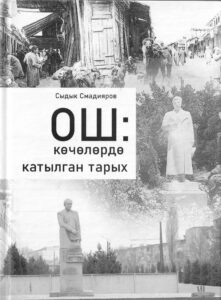
“Osh is one of the oldest cities in Central Asia. It is as old as ancient Rome.” These are the words with which Sydyk Smadiyarov, professor of history and archaeology at Osh State University, introduces his new book about this city that defines the history and culture of southern Kyrgyzstan. Today we will look at the content of this book – mainly because it is a regional publication (difficult to access) and, moreover, written in Kyrgyz language.
In the first chapter, the author systematically summarizes the current state of knowledge of the history of the city of Osh (scientific discourse by sinologist L. A. Borovkova; archaeologists K. Tashbayeva, A. N. Bernshtam, K. Maltaev; historian X. Tang, L. Zimin et al.) and its toponymies (Sulaiman Too, “Osh” and origin of its name). The most detailed description of the development of the city and the growth of its population naturally comes from recent times – from the period of Russian expansion into Central Asia and in the Soviet Union, when the growth of the Osh agglomeration was rapid and, in addition to the original (early 20th century) 30 thousand people, the current city has 200 thousand inhabitants.
The second part of the book is devoted to the main topic – a detailed analysis of the development of the city, its districts and street changes – for this reason, it focuses mainly on the modern history of the city (there is no information from older periods). Very interesting is the comparison of the concept of “city district” imported by the Russian administration and the original Arab concept of parts of the city as settlements (“mahalla”). The author is able to identify a number of historical and production districts (e.g. a district of craftsmen processing alabaster) based on the toponymy of today’s streets. Almost unbelievable (and emphasising the importance of town) is the fact there were 154 mosques, eight schools for Qur’an reciters, and five madrasas in the city of Osh at the end of the nineteenth century. The electricity appeared in 1913 in the town. However, with the arrival of a stable Russian garrison (Sergey Topornin, commander of the 4th Turkestan Battalion) and the planned geometric development of the “medieval” city, the face of the city changed significantly – the basic street axes laid out by imperial officers have remained to this day (Topornin is in a shadow of “famous” general Skobelev that organized the “Alay military-scientific expedition”in order to suppress the resistance of the Alay Kyrgyz. Thus, during the colonial period, one of the first main streets of Osh bore the name of this man. For Russians, however,
General Skobelev was regarded as a true patriot and a famous military figure.). One of the earliest structures in Osh during the Soviet period was the Osh fortress, built in May 1919 (for comparison – a functional city hospital was established only in 1968). It was located in the center of the new city and nothing preserved of its construction until today. Almost a century of Soviet rule meant the destruction of many traditional buildings and mosques and the complete renaming of the street network in the sense of Sovietization, as we know it from all over Eastern Europe and Central Asia (streets were given mainly the names of the founders of Marxism-Leninism, revolutionaries, heroes of the Civil War and the Great Patriotic War…) – all of those changes are described in the book in detail.
It was only after the collapse of the Soviet Empire and the national implementation of the Kyrgyz Republic that the streets were renamed again.
The publication and its explanatory part are richly illustrated with historical and current plans and photographs of the city of Osh. It is a pity that for those interested in this city who do not come directly from Osh, it is not supplemented with a detailed map with the location of these images.
Smadyarov, Sydyk. Osh: History Hidden in the Streets: Historical Essay. Book One. — Bishkek: Turar, 2022. — 186 pp. + 24 pp. of black-and-color inserts. ISBN 978-9967-85-151-6.
).